
Why Choose a Tray Sealer Packaging Machine?
Why Choose a Tray Sealer Packaging Machine? The answer begins with control. A tray sealer packaging machine forms a consistent seal around prepared food, meat, seafood, and ready meals. It can reduce oxygen exposure, limit leakage, and create cleaner retail presentation. The result is practical: a sealed tray, a tight film edge, and fewer unpleasant surprises during transport.
Industry evidence supports this direction. PMMI’s 2024 State of the Industry report identifies labor shortages, automation, and operational efficiency as continuing packaging priorities. Smithers’ The Future of Fresh Food Packaging to 2028 also highlights extended shelf life, food safety, and recyclable materials as major development drivers. Meanwhile, Grand View Research estimates the global food packaging market will continue growing strongly through 2030. These reports do not make every machine a wise investment. They show the pressure surrounding modern production.
Sterling Anthony, CPP, a recognized packaging consultant, defines packaging as “the science, art, and technology of enclosing and protecting products.” A tray sealer packaging machine puts that principle into daily practice. It can improve seal consistency, reduce manual handling, and support modified-atmosphere packaging when properly configured. However, automation is not magic. Wrong film, poor calibration, or careless cleaning can still damage product quality. That uncomfortable detail matters. Buyers should examine throughput, tray dimensions, sealing temperature, changeover time, and after-sales support before choosing equipment. A machine that looks impressive may still perform poorly on a wet production line. The best choice is not always the fastest one. It is the one that delivers repeatable results, measurable waste reduction, and dependable protection for the product.
What Is a Tray Sealer Packaging Machine?
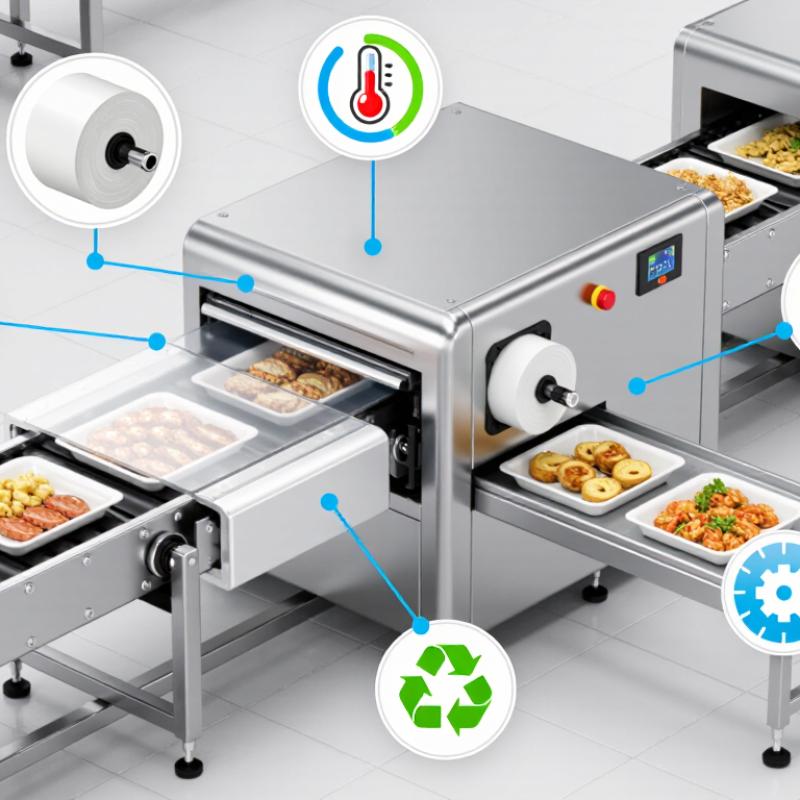
A tray sealer packaging machine seals products inside preformed trays using heat, pressure, and lidding film. Many models can remove air, add protective gas, print dates, and cut the film cleanly. The sealed tray creates a visible barrier against handling, moisture, and oxygen. It suits fresh meat, seafood, prepared meals, produce, and other temperature-sensitive foods. However, the machine is not a magic shield. Seal quality still depends on tray design, film compatibility, temperature, pressure, and product cleanliness.
The FAO’s 2019 State of Food and Agriculture estimated that 14% of food is lost between harvest and retail worldwide. Reliable sealing may help reduce some avoidable damage, especially during chilled distribution. Yet packaging must be measured carefully. Eurostat reported 188.7 kilograms of packaging waste per EU resident in 2021. More material is not automatically better. A practical specification should compare shelf-life results, film usage, energy consumption, changeover time, and rejected trays. PMMI’s 2024 State of the Industry report also identifies labor availability and production efficiency as continuing drivers for packaging automation.
Tips: Test the complete tray, film, and product combination before purchase. Check seal strength after refrigeration and transport simulation. Record leaks, wrinkles, and misaligned films. Small defects often reveal larger process problems. Do not choose speed alone; a slower, stable line can produce less waste.
Why Choose a Tray Sealer Packaging Machine? - What Is a Tray Sealer Packaging Machine?
| Evaluation Dimension | Typical Information | Why It Matters |
|---|---|---|
| Definition | A tray sealer is a packaging machine that places a heat-sealable film over a preformed tray and seals it around the tray rim. | It creates a consistent, hygienic package while reducing manual sealing work. |
| Common Applications | Fresh meat, poultry, seafood, prepared meals, vegetables, fruit, bakery products, and other chilled or ready-to-eat foods. | The machine can support different food formats when the tray, film, and sealing conditions are compatible. |
| Sealing Method | Heat sealing using a heated tool, pressure, and a suitable lidding film. | Controlled heat and pressure help produce repeatable seals and reduce leakage risk. |
| Typical Throughput | Approximately 4–20 cycles per minute for many semi-automatic and automatic configurations; actual output depends on tray size, cavities, product handling, and sealing time. | Throughput should be evaluated together with loading, unloading, film changes, and quality checks. |
| Tray Materials | Common options include polypropylene, polyethylene terephthalate, polystyrene, paper-based trays, and selected multilayer structures. | Material selection affects sealing compatibility, rigidity, barrier performance, recycling options, and product protection. |
| Film Requirements | The lidding film must be compatible with the tray rim and may be designed for peelable, weldable, anti-fog, high-barrier, or modified-atmosphere applications. | Film compatibility directly affects seal strength, opening performance, shelf life, and presentation. |
| Modified Atmosphere Packaging | Some tray sealers can evacuate air and introduce selected gases before sealing, provided the machine is equipped for this process. | Gas flushing may help maintain product quality, but the correct gas mixture and process validation are product-specific. |
| Seal Temperature | Often set within approximately 120–220 °C, depending on the tray-and-film structure and supplier specifications. | The correct temperature prevents weak seals caused by insufficient heat and deformation caused by excessive heat. |
| Tray Size Flexibility | A machine may handle one format or several formats by changing sealing tools and adjusting guides, depending on its design. | Format flexibility is valuable for businesses producing multiple products or pack sizes. |
| Automation Level | Semi-automatic models generally require manual tray loading, while automatic models can integrate conveyors, denesters, fillers, and discharge systems. | The appropriate level depends on production volume, labor availability, line layout, and budget. |
| Quality and Hygiene | Stainless-steel contact areas, smooth surfaces, removable components, and accessible sealing tools support routine cleaning. | Cleanable construction helps support food hygiene programs and reduces contamination risks when operated correctly. |
| Packaging Benefits | Consistent sealing, improved product visibility, reduced handling, better stacking, and compatibility with printed or transparent films. | These features can improve shelf presentation and packaging consistency across production batches. |
| Key Selection Factors | Product type, tray dimensions, required output, sealing method, film structure, gas-flushing needs, available floor space, and cleaning requirements. | Matching the machine to the product and packaging materials is essential for reliable performance. |
| Best Fit for Buyers | Food processors, central kitchens, retailers, caterers, and manufacturers that need repeatable tray sealing for small, medium, or high-volume production. | A tray sealer is most suitable when consistent presentation, sealing quality, and scalable production are important. |
Note: Performance ranges are typical industry guidelines. Actual results depend on the machine configuration, tray and film materials, product characteristics, operator workflow, and validated process settings.
Related Posts
-
Why Choose a Tray Sealer Packaging Machine?
-
Top 10 Types of Automatic Tray Sealing Machines
-
2026 How to Choose the Best Tray Sealer Packaging Machine?
-
What is an Automatic Blister Packing Machine and How Does It Work
-
2026 Best Clear Clamshell Packaging for Global Buyers?
-
How to Choose Blister Card Packaging for Global Sourcing?