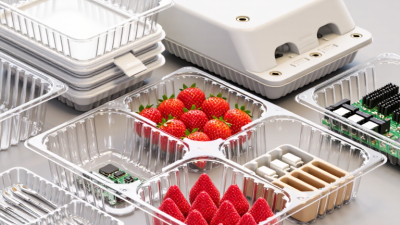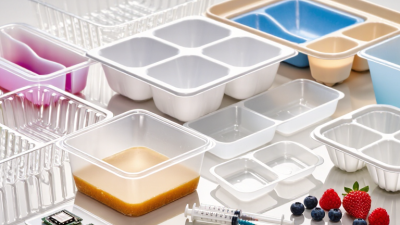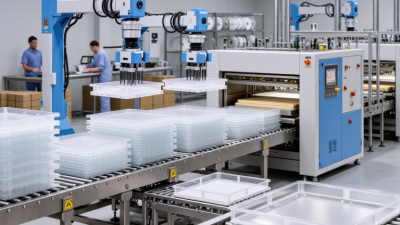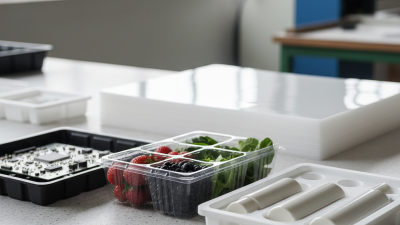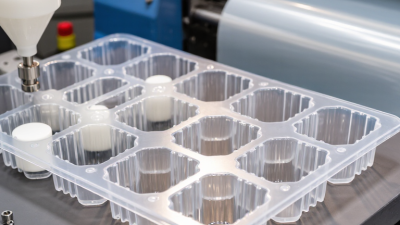
Choosing a thermoformed tray manufacturer is not just a search for the lowest quoted price. A tray must fit the product, protect it in transit, and work smoothly on filling or packing lines. A sample may look right on a desk, yet buckle under stacking pressure or leave too little room for an automated seal. Details matter.
This guide introduces ten manufacturers for global buyers, with practical factors to consider when comparing their capabilities. Look for clear information about materials, tray dimensions, tooling options, production capacity, and quality checks. For food, medical, or other specialized uses, confirm that a supplier can document the relevant material and process requirements for your application. Ask about sample approval, minimum order quantities, lead times, packaging, and shipping arrangements. These points can reveal more than a polished product catalogue.
There is no single best supplier for every project. A large producer may offer dependable volume, while a smaller specialist may provide closer support or more flexible design changes. The comparison should therefore be a starting point, not a substitute for checking references and testing samples under real conditions. Even experienced buyers can miss a small fit issue. A careful shortlist helps narrow the field, but the final decision depends on your product, market, budget, and production schedule.
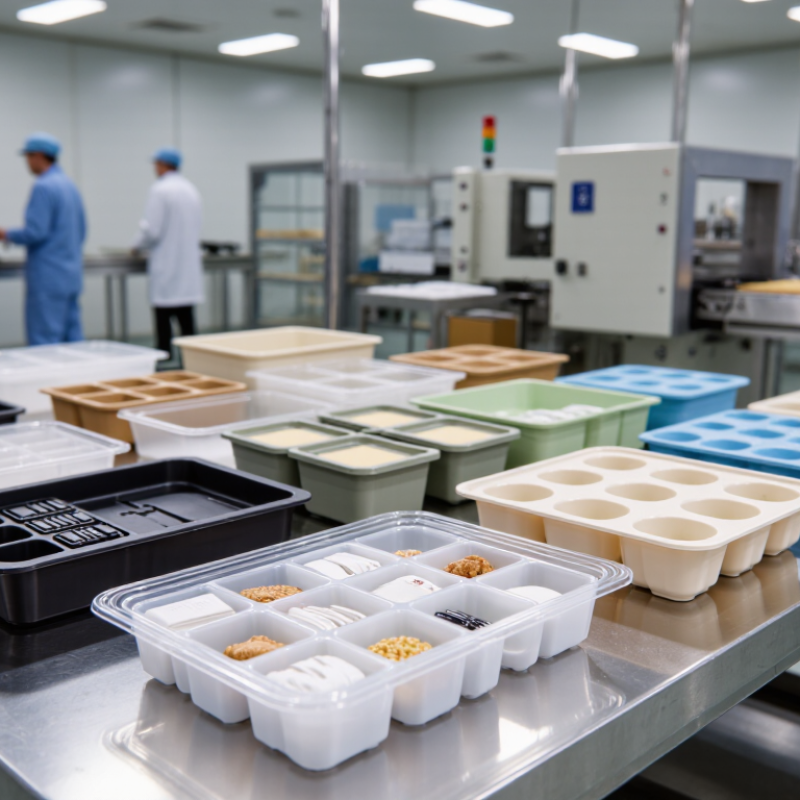
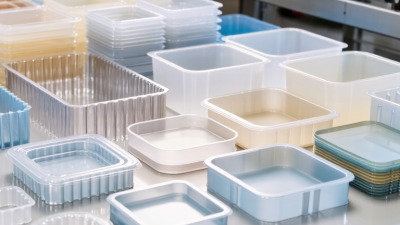
Thermoformed trays commonly use PET or PP sheet, but the right choice depends on the product and forming conditions. PET is typically clear and stiff, making it useful when buyers need product visibility and neat presentation. PP is more flexible and generally better suited to applications involving warmer filling or handling. Neither material wins every time. Deep cavities can thin at the corners, so a flat-sheet specification alone may not predict tray performance.
Typical sheet gauges range from 0.2 to 2.0 mm. Thin gauges can reduce weight, while thicker sheets may support heavier products; cavity depth, ribs, flange width, and stacking loads all matter.
PlasticsEurope’s Plastics—The Fast Facts 2023 reported global plastics production of 400.3 million tonnes in 2022, a broad market figure rather than a tray-specific measure. NAPCOR’s 2023 report put the 2022 U.S. PET bottle recycling rate at 29.1%. That figure covers bottles, not thermoformed trays, so it should not be treated as a tray recycling rate.
Tips: Ask for formed samples at the intended gauge, then check corners, seals, and stacking under real conditions. Small details matter. Compare material data carefully, and confirm whether figures describe sheet, packaging, or bottles.
Choosing among ten thermoformed-tray manufacturers requires comparing usable capacity, not brochure figures. Ask for output per shift using your tray dimensions, material, and cavity count. A line producing shallow trays may not match demand for deeper, heavier formats. Grand View Research valued the global thermoformed plastics market at US$48.8 billion in 2023 and forecast 5.3% annual growth through 2030. That market-wide estimate signals activity, but it does not guarantee any supplier’s available capacity. Request recent production records, typical lead times, and a clear explanation of how planned maintenance affects delivery.
Tooling can change the economics quickly. Compare the quoted mold cost, expected service life, repair terms, and ownership rights. Ask whether a design change requires a new mold or a smaller insert modification. Get the minimum order quantity for each resin and color; setup time, sheet availability, and storage can all affect it. Small orders matter. PlasticsEurope reported 413.8 million tonnes of global plastics production in 2023, but this broad figure says little about tray-grade material availability. Confirm resin sourcing directly. Capacity comparisons are not always tidy: suppliers may count shifts, scrap, and product mix differently. Request like-for-like figures, then test a sample run before committing to larger volumes.
Buyer-oriented comparison of common supplier capability profiles. Capacity and MOQ figures are indicative planning ranges, not verified data for specific manufacturers. Actual figures vary by tray dimensions, material, cavities, production schedule, and quality requirements; confirm them directly during quotation.
| Supplier Capability Profile | Indicative Annual Capacity (Dedicated Line) |
Common Tooling Approach | Indicative MOQ for Custom Orders | Often Suited To | What Buyers Should Verify |
|---|---|---|---|---|---|
| 1. Regional custom-packaging producer | About 1–5 million trays | Aluminum production mold; prototype tooling may be available | About 5,000–25,000 units | Regional food, retail, and industrial applications | Tool ownership, changeover charges, and delivery coverage |
| 2. High-volume food-tray producer | About 10–50 million trays | Multi-cavity production tooling designed for repeat runs | About 25,000–100,000 units | Standard food trays and large recurring programs | Food-contact documentation, line capacity, and forecast flexibility |
| 3. Medical-packaging specialist | About 2–15 million trays | Precision tooling; controlled production and inspection processes may apply | About 10,000–50,000 units | Medical-device and healthcare packaging projects | Quality-system scope, cleanroom needs, validation, and traceability |
| 4. Electronics and industrial-tray producer | About 1–10 million trays | Custom molds; conductive or static-dissipative materials may be specified | About 5,000–30,000 units | Component handling, assembly, and reusable-loop packaging | ESD test method, dimensional tolerances, and material consistency |
| 5. Recycled-content packaging producer | About 3–20 million trays | Production tooling matched to recycled or mixed-material sheet | About 10,000–50,000 units | Projects with recycled-content or material-reduction goals | Recycled-content evidence, food-contact suitability, and color variation |
| 6. Fiber-based formed-tray producer | About 2–20 million trays | Forming screens or molds; drying and finishing requirements depend on design | About 10,000–50,000 units | Protective, produce, and selected food-packaging applications | Moisture performance, barrier needs, surface finish, and end-of-life claims |
| 7. Thin-gauge retail-tray producer | About 5–30 million trays | Multi-cavity tooling optimized for lightweight, repeatable parts | About 20,000–75,000 units | Point-of-sale, bakery, produce, and retail presentation trays | Stacking, nesting, trim quality, and performance at reduced material weight |
| 8. Heavy-gauge protective-tray producer | About 0.5–5 million trays | Robust single- or multi-cavity molds for thicker sheet and larger parts | About 2,000–20,000 units | Equipment, automotive, and durable-goods protection | Part strength, wall thickness, dimensional stability, and shipping tests |
| 9. Prototype and short-run producer | About 0.1–2 million trays | Prototype or lower-cost tooling may be offered before production tooling | About 500–10,000 units | Sampling, market tests, and early-stage product launches | Prototype-to-production consistency, tooling upgrade cost, and lead time |
| 10. Export-oriented contract producer | About 5–40 million trays | Custom production tooling; export packing and documentation can be arranged | About 20,000–100,000 units | Buyers consolidating recurring orders across multiple markets | Incoterms, export packaging, compliance documents, and total landed cost |
Comparison note: Thermoforming output depends on tray size, cycle time, number of cavities, material, uptime, and shift pattern. MOQ is a commercial quotation term rather than a fixed industry standard. Request a written capacity basis, tooling quotation, sample approval plan, and MOQ breakdown for each shortlisted supplier.
For buyers comparing thermoformed tray manufacturers, EU 10/2011 is a useful reference for plastic food-contact materials. It sets an overall migration limit of 10 mg/dm² under applicable test conditions. This is not a universal pass mark for every tray and every food. The test must reflect intended use, including contact time, temperature, and food type. A chilled salad tray and a tray used for hot filling may need different assessments.
Ask suppliers for relevant migration reports and a declaration of compliance, then check that the documents match the actual tray structure. Material grade, wall thickness, recycled content, and surface layers can affect results. For example, a report for a flat sample may not represent a deeply formed corner. That detail is easy to miss. Testing should use suitable food simulants and conditions, with specific migration limits considered where relevant.
Good documentation helps, but it cannot replace process control. Forming temperature, trimming, and changes in resin can alter the finished article. Paperwork can look tidy; production is less tidy. Buyers should clarify how changes are reviewed and which batches are traceable. Even careful suppliers may need to retest after a material or process change. The awkward question is often the useful one: does this evidence cover the tray you will actually receive?
Medical trays are often mistaken for complete sterile barrier systems. Under ISO 11607-1, the system must maintain sterility until the point of use. A thermoformed tray may support that system, but usually works with a lid, pouch, or other closure.
Material selection needs more than a clear view of the device. Check compatibility with the product and the intended sterilization process. Assess barrier properties, cleanliness, forming consistency, and resistance to handling damage. Small details matter. A sharp tray corner, for example, can stress a lid seal during transport. The standard also calls for packaging materials and systems to be evaluated for their intended use. It does not make every tray suitable by default.
Look at the assembled package, not just a sample tray on a desk. Testing should reflect actual device dimensions, sealing conditions, sterilization exposure, and distribution risks. Seal-process validation is addressed in ISO 11607-2, while Part 1 covers material and system requirements. Keep records of specifications, test methods, and changes to the design. A transparent tray may look reassuring, but appearance alone proves little. Teams sometimes discover that late. A practical review with packaging, quality, and clinical staff can reveal opening or handling problems before routine production.
The timeline shows published editions of ISO 11607-1: the 2006 edition, the 2019 edition, and Amendment 1:2023. The standard addresses materials, sterile barrier systems, and packaging systems for terminally sterilized medical devices. A thermoformed tray should be assessed as part of the complete sterile barrier and packaging system; compliance depends on the applicable requirements and validation evidence, not the tray alone.
ASTM D4169 helps evaluate how packaged thermoformed trays may withstand hazards during distribution. Depending on the selected distribution cycle and assurance level, testing can include vibration, drops, compression, and other handling stresses. A tray is usually tested in its shipping configuration, such as inside a carton with its normal dividers and cushioning. This matters because an empty tray on a bench behaves differently from a loaded tray inside a stacked case.
Damage can be subtle. A corner may crack, a rim may deform, or stacked trays may stick together after vibration. Record the packaging configuration, product load, and test sequence so results can be compared across design changes. Testing should reflect the expected shipping route, not an imagined worst case alone. Even then, a laboratory simulation cannot reproduce every warehouse floor or delivery van. That limitation deserves attention.
Tips: Photograph trays before and after testing. Check corners, nesting, seals, and fit with the product. If damage appears, change one packaging feature at a time and retest. Small changes can help, but they do not prove performance on every route.